
Softness After Survival
A glimpse of the evolution of the Black Woman's self sacrifice.

The Nature of Compassion
There was a time when I didn’t think of compassion as a choice.
It felt more like a lens I was born with. The way I saw the world. The way I made sense of people. I could walk into a room and almost immediately begin filling in the gaps for others, why they said what they said, why they moved the way they moved, what they might have been carrying long before they ever crossed my path. It wasn’t forced. It wasn’t strategic. It was just… how I was.
And for a long time, I believed that if I could just see people clearly enough, deeply enough… then maybe I could love them in a way that made everything softer… safer… better.
But life has a way of interrupting that kind of innocence.
Not all at once. Not dramatically, at first. Just small moments. Subtle disappointments. Times where understanding someone didn’t change the outcome. Times where giving the benefit of the doubt still left you holding the weight of someone else’s decisions.
And then, over time, the pattern becomes harder to ignore.
You start to realize that seeing the best in people does not protect you from the reality of who they choose to be, teaching you that compassion, when left unguarded, can quietly become a place where you abandon yourself. And that no matter how expansive your heart is, it does not exempt you from being hurt.
That realization doesn’t make you bitter.
But it does make you aware.
And awareness changes things.
It introduces a question that maybe you never had to ask before:
What is this costing me?
Not in that cold or transactional way. But in a deeply honest one. Because when you’ve experienced enough loss, enough disappointment, enough moments where you showed up fully and left feeling depleted, you can’t unsee that.
So something shifts.
Compassion, which once felt like a constant state, becomes a decision. A living, breathing decision. One that meets you in every room, every conversation, every new connection and quietly asks:
Is this a space where I can safely be who I am?
And maybe even more importantly:
Can my softness live here without being mishandled?
For some of us, especially those of us who have always been “this way” this shift can feel like a loss at first.
Because there is a version of you that could exist everywhere.
A version of you that didn’t hesitate. That didn’t measure. That didn’t pause to consider whether it was safe to be open, to be giving, to be fully present.
And slowly, you realize… she can’t go everywhere with you anymore.
And that realization carries a quiet kind of grief.
Because you’re not just setting boundaries. You’re building a new relationship with a version of yourself that once felt natural.
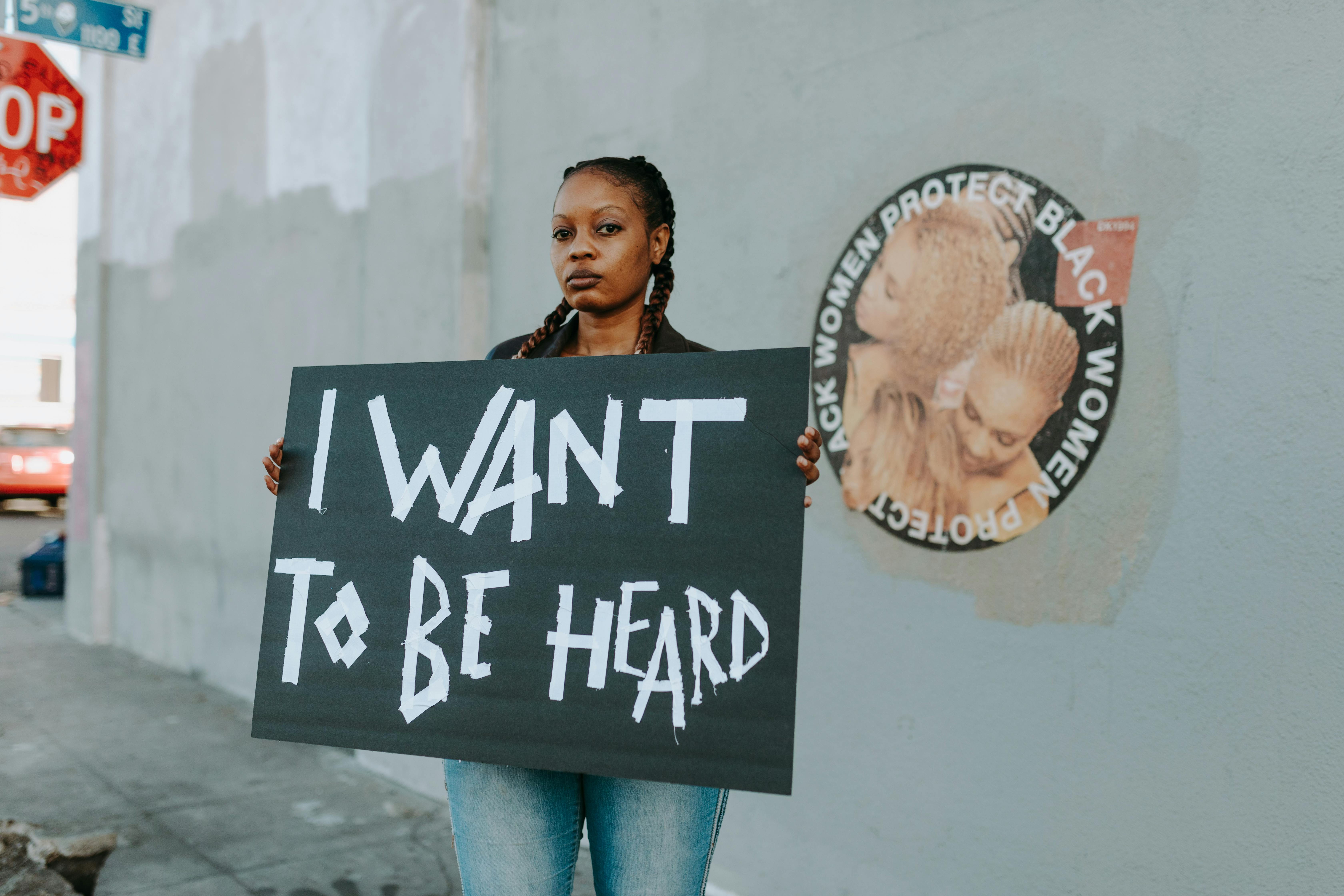
Historical and Cultural Perspective
Because there is a particular kind of woman who has been taught, both explicitly and implicitly, that her capacity to hold others is her greatest strength. A woman who knows how to read a room before she even sits down. Who knows how to make space, how to extend grace, how to love people through their contradictions.
In many Black communities, that archetype is not just familiar, it’s expected.
We have inherited a legacy of emotional labor that didn’t begin with us. Generations of women who had to be resilient, intuitive, accommodating, and endlessly giving, not because it was romantic but because it was necessary for survival.
Softness wasn’t always something we got to experience freely. It was something we learned to offer, even when we didn’t receive it in return.
And when I think about where that comes from, how deep it runs, I think about women like Harriet Tubman.
A woman, yes but also, in many ways, a martyr.
Not in the abstract. Not symbolically. But in the real, lived sense of what it means to put your life on the line over and over again for the freedom of others. To move with a level of courage, intuition, and spiritual conviction that required her to override her own safety for something larger than herself.
And even in that; there are details we don’t always sit with.
While she was risking her life, conducting the Underground Railroad, returning again and again to lead others to freedom, her husband chose another life. Another woman.
And that detail doesn’t diminish her.
If anything, it sharpens the reality of what self-sacrificial compassion has looked like for Black women across time.
Giving. Leading. Saving.
And still being left to hold the cost of it.
That kind of strength, that kind of self-sacrificial compassion, is not disconnected from us. It didn’t disappear. It was passed down. Refined. Remembered in the body, even when the circumstances changed.
And it didn’t stop with her.
For many of us, this isn’t just 1800s history.
This is our grandmothers.
Our great-grandmothers.
Sometimes even our mothers.
Women who marched. Who organized. Who registered voters. Who held families together while fighting for civil rights. Women who carried entire communities forward, often without the language of “rest” or “boundaries” or “self-preservation.”
So when we find ourselves being the ones who hold space, who anticipate needs, who extend grace beyond what feels reasonable… it makes sense.
When Inheritance Meets Awareness
There is nothing confusing about how we got here.
It is adaptation.
It is inheritance.
It is survival turned into identity.
And psychologically, that matters.
Because we don’t just inherit stories, we inherit patterns.
We inherit ways of relating. Ways of loving. Ways of surviving.
You can grow up watching women who were the caregivers, the providers, the emotional anchors and without ever consciously deciding it, you begin to internalize that as the standard.
It shapes how you show up in relationships.
How you view partnership.
How much you feel responsible for holding things together.
Sometimes consciously.
Often unconsciously.
So you find yourself overextending. Overgiving. Overexplaining.
Not because you chose it but because, somewhere along the line, it was modeled as necessary.
But what happens when the environment changes and the strategy stays the same?
What happens when the very thing that once helped us survive begins to cost us something different?
Because while the world has shifted, and while many of us are no longer navigating the exact same conditions that required that level of life-risking sacrifice, it would be dishonest to pretend that everything is resolved. There are still very real systemic pressures. There are still environments where Black women are asked, directly and indirectly; to carry more, to endure more, to give more.
That reality has not disappeared.
So this is not a dismissal of that truth.
This is not a call to abandon one another.
And it is certainly not an argument that the responsibility to fix these conditions falls on Black Women.
It does not.
But within the spaces where we do have choice, where we do have some level of control, some level of safety, some level of agency; there is a quiet invitation to evolve.
And I’m speaking for myself here.
And maybe, if it resonates, an invitation for you to consider it too.
Choosing Preservation
Because something has shifted.
There was a time when self-sacrificial compassion saved lives.
And now, in some ways, it is costing us ours.
Not always physically.
But emotionally.
Mentally.
Spiritually.
And that is an indication that something within us has to be re-examined.
Not erased.
Not rejected.
But stewarded differently.
Because if strength lives in our bones, and it does… then part of honoring that strength is learning how to use it in ways that also preserve us.
And for many of us, that is unfamiliar work.
We come from lineages of women who did what they had to do, often without the luxury of choosing themselves. Self-preservation, in the way we’re being asked to consider it now, was not always available. So of course it feels unnatural to pause. To consider our own capacity. To say, “this is too much for me.”
But that doesn’t make it wrong.
It makes it new.
And maybe even necessary.
Because evolution doesn’t mean we lose what we’ve inherited.
It means we learn how to carry it differently.
Where Compassion Lives Now
So we don’t have to stop being compassionate.
We just have to stop offering it in ways that cost us everything.
We don’t have to stop being soft.
We just have to stop placing that softness in spaces that mishandle it.
We don’t have to disconnect from others.
But we do have to stay connected to ourselves.
This could look like small, almost unremarkable decisions.
Like not answering the call right away when you know you don’t have the capacity.
Like not over-explaining your boundaries just to make someone else more comfortable.
Like allowing people to sit with their own misunderstandings of you instead of rushing to clarify or soften yourself.
Like noticing when your body feels tight, when your energy shifts, and honoring that without needing external validation.
Like walking away; from people, from relationships, from jobs, from communities that do not take your safety into consideration, that do not prioritize your well-being, that do not a create space for you to rest and exist without being in a constant state of giving.
Not as a rulebook.
Not as a final answer.
But as one of many ways this shift can begin to take shape in real life.
And just as important, this is not about shutting people out. It’s about letting the right people fully in.
It’s about creating space where your softness is not just expressed, but received with care. Where your presence is not just tolerated, but valued. Where you are not constantly negotiating your worth in order to belong.
And for those of us who hold faith close, who have been taught about commitment, covenant, endurance this conversation can become even more layered.
Because when belief and survival patterns intersect, it can be difficult to discern where devotion ends and self-abandonment begins.
I don’t have the space to fully hold that here.
But I do believe it deserves its own careful, honest conversation.
And maybe that’s the shift.
Not from love to detachment.
But from self-sacrifice to self-honoring.
From instinctive giving to intentional placement.
From inherited survival to chosen preservation.
So now, compassion becomes a question again:
Where does it get to live?
Where does it get to grow?
And just as importantly
Where does it no longer belong?
And maybe, even here, there is still room for something gentle to exist.
Not the kind of softness that ignores reality.
But the kind that remains… even after you’ve seen it clearly.
The kind that says:
I can still love.
I can still hope.
I can still be who I am.
Just not at the cost of myself.